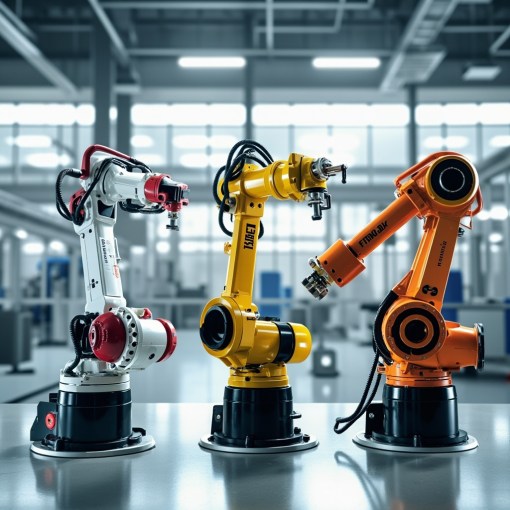
Industrial robots have become essential to modern manufacturing, with the global market continuously expanding as companies seek to improve efficiency, precision, and productivity. Among the leading manufacturers in this space, three brands consistently stand out: ABB, FANUC, and KUKA. Each of these industrial robotics giants has established itself as a trusted name across various sectors, from automotive assembly to electronics manufacturing. Choosing the right robot brand for your operation requires understanding the unique strengths, programming approaches, and application capabilities that each company brings to the table.
This comprehensive comparison examines the key differences between ABB, FANUC, and KUKA robots, helping you make an informed decision based on your specific production requirements, budget constraints, and long-term operational goals.
## Company Backgrounds and Market Position
**ABB Robotics** is a division of the Swiss-Swedish multinational corporation ABB Group. The company has been at the forefront of industrial automation for decades and offers one of the broadest portfolios of robotics solutions in the industry. ABB’s strong global presence and extensive distribution network make it a popular choice for manufacturers worldwide.
**FANUC Corporation**, headquartered in Japan, is the largest manufacturer of industrial robots in the world by unit sales. The company is renowned for its highly reliable and precise robotics systems, with a particular stronghold in the automotive and semiconductor industries. FANUC’s vertical integration model allows for exceptional quality control across all components.
**KUKA AG**, based in Germany and now part of the Midea Group, specializes in high-quality robotics solutions with particular expertise in heavy-duty applications. KUKA robots are known for their robust construction and excellent performance in demanding industrial environments, making them a preferred choice for automotive manufacturing and general industry applications.
## Technical Specifications Comparison
When evaluating industrial robots, several technical parameters serve as the primary decision-making factors. The following table provides a side-by-side comparison of key specifications across common robot models from each manufacturer.
| Specification | ABB IRB 6700 | FANUC M-20iD | KUKA KR 60 |
|---|---|---|---|
| Payload Capacity | Up to 300 kg | Up to 25 kg | Up to 90 kg |
| Reach Range | 1.85m – 3.2m | 1.83m – 2.04m | 1.6m – 2.03m |
| Repeatability | ±0.05mm – ±0.1mm | ±0.02mm – ±0.05mm | ±0.03mm – ±0.06mm |
| Axis Configuration | 6-axis standard | 6-axis standard | 6-axis standard |
| Protection Rating | IP67 optional | IP67 standard | IP65 standard |
FANUC robots typically excel in precision and repeatability, making them ideal for applications requiring extreme accuracy such as semiconductor manufacturing and high-precision assembly operations. ABB offers excellent payload capacities suited for heavy material handling and machine tending, while KUKA provides robust solutions that balance payload with reach requirements effectively.
## Programming and Control Systems
The programming approach differs significantly between these manufacturers, which directly impacts integration complexity and operator learning curves.
ABB’s RobotStudio software provides a powerful offline programming and simulation environment that allows engineers to develop and test robot programs without interrupting production. The software features intelligent path planning and collision detection, significantly reducing commissioning time. ABB uses the RAPID programming language, which is intuitive for programmers familiar with structured text-based languages.
FANUC employs the Karel programming language along with its proprietary software platform. While Karel is considered more complex than some alternatives, FANUC offers an intuitive teach pendant interface that many operators find accessible. The R-30iB and R-30iB Plus controllers provide robust performance with extensive I/O capabilities. FANUC’s iRVision system is particularly well-integrated, offering sophisticated vision-guided robotics capabilities.
KUKA uses the KRL (KUKA Robot Language) for programming and offers the KUKA.WorkVisual software suite for offline programming and system configuration. KUKA’s teach pendant interface is known for its user-friendly design, and the company’s SmartHMI interface makes programming more accessible to operators with less coding experience.
## Application Suitability and Industry Strengths
Each manufacturer has developed particular expertise in specific application areas, which can influence purchasing decisions based on your production focus.
**ABB** demonstrates exceptional capability in material handling, spot welding, and arc welding applications. The company’s RobotStudio simulation tool is particularly valuable for complex integration projects. ABB’s FlexPendant interface provides excellent flexibility for operators, and the TrueMove and QuickMove motion control technologies deliver optimized path accuracy across various applications.
**FANUC** dominates in applications requiring high-speed performance and precision, including pick-and-place operations, assembly, and painting. The company’s extensive range of Foundry Pro robots is specifically designed for harsh manufacturing environments with superior protection against dust, moisture, and high temperatures. FANUC’s strong presence in the automotive sector, particularly for body-in-white applications, demonstrates its reliability in high-volume production environments.
**KUKA** excels in heavy payload applications and automated manufacturing cells. German engineering excellence is evident in KUKA’s robust construction and excellent mechanical precision. The company is particularly strong in automotive applications, including press tending, machine loading, and large-part handling. KUKA’s expertise in collaborative robotics, with the LBR iiwa series, provides options for human-robot collaboration scenarios.
## Maintenance, Support, and Total Cost of Ownership
Understanding the long-term maintenance requirements and support infrastructure is crucial for calculating the total cost of ownership beyond the initial purchase price.
ABB offers comprehensive global support through its extensive network of authorized service centers and distributors. The company’s Ability platform enables remote monitoring and predictive maintenance capabilities, helping minimize unplanned downtime. ABB robots are known for their reliability, and spare parts availability is generally strong in most regions.
FANUC’s vertically integrated manufacturing approach means that components are designed to work together optimally, potentially reducing compatibility issues. The company provides extensive training programs and has a reputation for exceptional long-term reliability. FANUC robots typically require less frequent maintenance compared to competitors, though replacement parts can be more expensive when needed.
KUKA maintains strong service networks, particularly in Europe and North America. The company’s digital services and IIoT capabilities through KUKA Connect offer advanced monitoring and analytics features. German manufacturing standards contribute to exceptional build quality, though KUKA robots may come with a higher initial investment compared to some alternatives.
## Ecosystem and Integration Capabilities
Modern manufacturing rarely involves stand-alone robotic cells. Integration with broader automation systems, PLCs, and manufacturing execution systems plays a vital role in operational efficiency.
ABB’s RobotStudio seamlessly integrates with CAD/CAM systems and offers direct connectivity to various PLC platforms through standard industrial protocols. The company’s IRC5 controller provides excellent flexibility for integration with external equipment, and ABB’s strong position in industrial automation and control systems (through their broader portfolio) facilitates comprehensive factory automation solutions.
FANUC’s Fieldbus and Ethernet IP capabilities are well-developed, allowing straightforward integration with most major PLC brands and industrial networks. The company’s focus on proprietary integration between its robots, controllers, and peripheral devices ensures optimized performance within FANUC-centric ecosystems.
KUKA offers excellent integration capabilities through standard interfaces and protocols. The company’s KR C4 controller provides a unified automation platform that combines robot control, PLC functionality, and safety systems in a single architecture, simplifying system complexity and reducing cabinet space requirements.
## Making Your Selection: Key Decision Factors
Choosing between ABB, FANUC, and KUKA ultimately depends on your specific operational requirements and strategic priorities. Consider the following factors when making your decision.
If your applications demand maximum precision and repeatability, FANUC’s tight tolerances make it an excellent choice, particularly for electronics assembly and similar high-accuracy operations. For heavy payload requirements exceeding 100kg, ABB’s high-capacity models provide solutions that competitors struggle to match in terms of reliability and performance.
Companies prioritizing ease of use and quick deployment may find KUKA’s intuitive interface and excellent documentation particularly valuable. The German engineering and robust construction of KUKA robots also appeal to manufacturers in regions with stringent quality requirements.
## Conclusion and Recommendations
ABB, FANUC, and KUKA each represent premium-quality solutions that can serve demanding industrial applications effectively. The “best” choice ultimately depends on your application requirements, existing ecosystem investments, and operational priorities.
For manufacturers requiring high payloads and robust material handling capabilities, ABB stands out with its extensive range of heavy-duty robots and powerful simulation tools. Those prioritizing ultimate precision in applications like electronics or semiconductor manufacturing may find FANUC’s superior repeatability specifications most compelling. Companies seeking German engineering quality with excellent ease of use may gravitate toward KUKA’s balanced approach to performance and operator accessibility.
Regardless of which brand you select, investing in proper operator training, preventive maintenance programs, and adequate spare parts inventory will maximize your return on investment and ensure reliable long-term performance. Each of these manufacturers offers proven, reliable solutions that can significantly enhance your manufacturing capabilities when matched appropriately to your specific application requirements.