
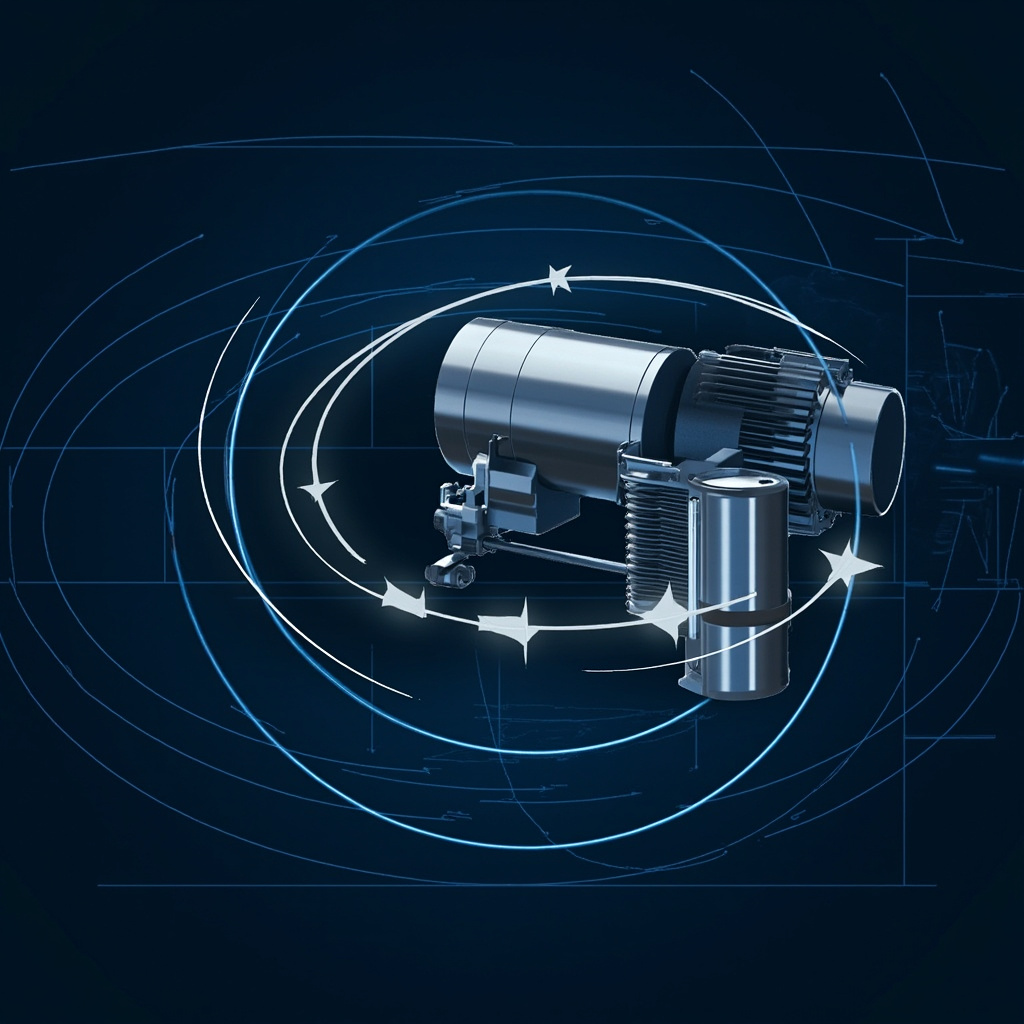
Servo motor inertia matching represents one of the most critical considerations in motion control system design. When engineers and technicians fail to properly account for the relationship between motor inertia and load inertia, the resulting system can experience significant performance issues including oscillation, overshoot, settling problems, and premature component failure. Understanding the principles behind inertia matching enables designers to create responsive, stable, and efficient motion control systems that meet precise positioning requirements across industrial automation, robotics, CNC machinery, and countless other applications where accuracy and reliability are paramount.
Understanding Motor Inertia and Load Inertia
Inertia, in the context of rotational motion, refers to an object’s resistance to changes in its state of rotation. This property, quantified by the moment of inertia, plays a fundamental role in determining how a servo motor will respond to control commands. The moment of inertia depends on both the mass of an object and the distribution of that mass relative to the axis of rotation.
Motor inertia, sometimes called rotor inertia, is the inherent moment of inertia of the servo motor’s rotating components, including the rotor, shaft, and any integrated encoders or brakes. This value is typically provided by the motor manufacturer in specifications such as kg·cm² or oz·in². Load inertia, on the other hand, represents the total moment of inertia that the motor must accelerate and decelerate during operation, encompassing all driven components from belts and pulleys to lead screws, couplings, workpieces, and tool holders.
The Critical Importance of Inertia Matching
The relationship between motor inertia and load inertia directly impacts several key performance characteristics of a servo system. When the load inertia is too high relative to motor inertia, the system becomes sluggish and difficult to control precisely. The motor struggles to accelerate and decelerate the load quickly enough to follow the desired motion profile, resulting in poor dynamic response and increased positioning errors during high-speed moves or rapid direction changes.
Conversely, when load inertia is too low compared to motor inertia, different problems emerge. The system may become overly sensitive to control commands, leading to mechanical resonance, vibration, and unstable operation. Small disturbances can cause excessive oscillation, and the system may exhibit hunting behavior where it continuously overshoots and corrects around the target position.
Performance Impacts of Improper Inertia Matching
- Reduced system bandwidth – The maximum frequency at which the system can respond to commands decreases significantly
- Increased settling time – Position stabilization after a move takes longer than specified
- Position error during motion – Following error increases, compromising accuracy
- Mechanical stress – Excessive torque requirements cause premature wear on bearings, couplings, and transmission components
- Motor overheating – Continuous operation at high torque levels can exceed thermal limits
- Resonance and vibration – System instability causes audible noise and accelerated fatigue failure
The Ideal Inertia Ratio: Finding the Sweet Spot
Industry standards and practical experience have established general guidelines for acceptable inertia ratios in servo motor applications. While specific requirements vary depending on the application and performance demands, the following table provides a framework for understanding typical acceptable ranges:
| Inertia Ratio (Load/Motor) | Performance Level | Typical Applications | Considerations |
|---|---|---|---|
| 1:1 to 3:1 | Excellent | High-precision positioning, direct-drive systems | Maximum dynamic response and control |
| 3:1 to 5:1 | Good | General automation, packaging equipment | Standard industrial applications |
| 5:1 to 10:1 | Acceptable | Material handling, conveyor systems | May require tuning adjustments |
| 10:1 to 30:1 | Challenging | Heavy machinery, large rotary tables | Advanced tuning required, gearboxes recommended |
| >30:1 | Problematic | Rarely acceptable without gearbox reduction | Significant performance limitations expected |
General rule of thumb: Most servo motor manufacturers recommend keeping the load-to-motor inertia ratio below 10:1 for standard applications, and below 5:1 for applications requiring high dynamic performance. Ratios exceeding 30:1 typically require mechanical solutions such as gearboxes, timing belts with reduction pulleys, or other transmission mechanisms.
Calculating Load Inertia: A Step-by-Step Approach
Accurate load inertia calculation forms the foundation of successful inertia matching. The calculation methodology depends on the type of mechanical transmission connecting the motor to the load. Below are common calculation scenarios:
Direct-Coupled Loads
For loads directly coupled to the motor shaft without gearbox or belt reduction, the load inertia simply equals the inertia of the driven component:
Jload = Jcomponent
Load Through Gearbox
When a gearbox is present, the load inertia must be reflected back to the motor shaft, accounting for the gear reduction ratio:
Jreflected = Jload ÷ R²
where R represents the gear reduction ratio. This relationship demonstrates why gearboxes are effective for inertia matching—the reduction ratio squared dramatically reduces the reflected load inertia seen by the motor.
Common Load Inertia Formulas
- Solid cylinder (rotating about its axis): J = (1/2) × m × r²
- Hollow cylinder: J = (1/2) × m × (r₁² + r₂²)
- Thin-walled hoop: J = m × r²
- Rectangular prism: J = (1/12) × m × (w² + h²)
- Lead screw (linear to rotary): Jreflected = m × (p / 2π)² where p = lead distance
- Belt and pulley system: Consider both pulleys, account for speed reduction
⚠️ Important Tip: Verification Over Assumption
Always verify your inertia calculations through testing. Manufacturer specifications, while helpful, may not account for all system components or real-world variations. Use the servo motor’s inertia auto-tuning function as a starting point, but perform frequency response analysis to confirm stability margins. Conservative estimates with subsequent empirical validation ensure reliable system operation.
Methods for Achieving Proper Inertia Matching
When initial calculations reveal an unfavorable inertia ratio, several mechanical and system design approaches can bring the system into an acceptable range:
Browse topics
Categories
Latest insights
Recent posts
- Mastering Multi-Task Program Management: Strategies for Success in 20262026年8月31日
- Coordinate System Switching: A Complete Guide to Seamless Map Projections Transformation2026年8月29日
- Understanding Program Loop Execution: A Complete Guide to Efficient Iteration in Code2026年8月27日
- How to Calculate MTTR (Mean Time to Repair): Formula, Examples & Best Practices2026年8月25日
- MTBF Calculation: A Complete Guide to Mean Time Between Failures2026年8月23日
Browse topics
Categories
Latest insights
Recent posts
- Mastering Multi-Task Program Management: Strategies for Success in 20262026年8月31日
- Coordinate System Switching: A Complete Guide to Seamless Map Projections Transformation2026年8月29日
- Understanding Program Loop Execution: A Complete Guide to Efficient Iteration in Code2026年8月27日
- How to Calculate MTTR (Mean Time to Repair): Formula, Examples & Best Practices2026年8月25日
- MTBF Calculation: A Complete Guide to Mean Time Between Failures2026年8月23日
Discover more from Xiamen Lisen Trading Co., Ltd
Subscribe now to keep reading and get access to the full archive.