
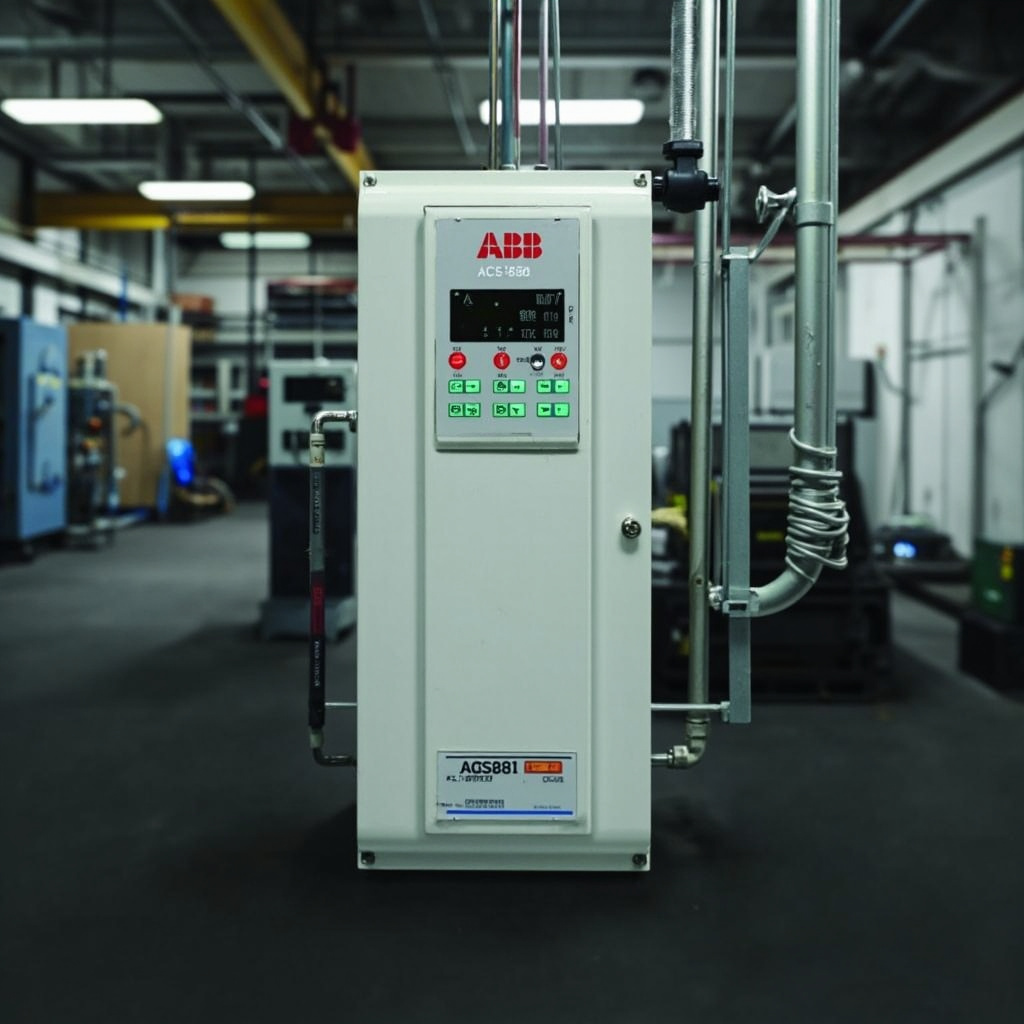
ABB ACS880 VFD Commissioning: Motor Identification, Application Macro Selection, Speed Torque Control, Safe Torque Off Function
Introduction
Commissioning variable frequency drives (VFDs) like the ABB ACS880-01-169A-3 ABB ACS880-01-169A-3 Variable Frequency Drive is a critical process for ensuring optimal performance and reliability in industrial applications such as pumps, fans, conveyors, and mixers. A systematic commissioning procedure is essential to achieve accurate motor control, efficient operation, and most importantly, personnel safety.
The first step in commissioning an ABB ACS880 VFD is the motor identification run, which is crucial for the drive to accurately control the motor’s speed and torque. This process ensures that the drive understands the motor’s characteristics, enabling precise control and protection. Following this, selecting the appropriate application macro can significantly expedite the setup process, providing pre-configured settings tailored to specific applications.
Another critical aspect of commissioning is configuring the Safe Torque Off (STO) function, which is essential for ensuring the safety of personnel working around the machinery. The STO function ensures that the drive can be quickly and safely shut down in case of an emergency, preventing unintended motor movement.
In this article, we will delve into the detailed steps for commissioning the ABB ACS880 VFD, including motor identification, application macro selection, speed and torque control, and the implementation of the Safe Torque Off function. We will also provide a comparison table of the ABB ACS880 against competing industrial VFDs and address some frequently asked questions.
Motor Nameplate Data Entry and Identification Run
Motor Nameplate Data Entry
Before initiating the identification run, it is essential to enter the motor’s nameplate data into the ABB ACS880 VFD. This data includes:
- Rated Voltage: The operating voltage of the motor, typically found on the motor’s nameplate. For example, 400 V for a standard three-phase motor.
- Rated Current: The current drawn by the motor at its rated load. This value is crucial for setting the drive’s current limits.
- Rated Frequency: The frequency at which the motor is designed to operate, usually 50 Hz or 60 Hz.
- Rated Speed: The motor’s speed at rated load, typically in revolutions per minute (RPM).
- Rated Power: The motor’s power rating, usually in kilowatts (kW) or horsepower (HP).
- Motor Pole Number: The number of poles in the motor, which determines the motor’s synchronous speed.
Scalar Control vs Vector Control
The ABB ACS880 supports both scalar (V/f) control and vector control modes. Scalar control is simpler and suitable for applications where precise speed control is not critical, such as fans and pumps. Vector control, on the other hand, provides more accurate speed and torque control, making it ideal for applications like conveyors and mixers.
Identification Run Procedure
Stationary Identification Run
- Enter Motor Data: Input the motor’s nameplate data into the drive’s control panel.
- Select Scalar Control: Set the control mode to scalar (V/f) for the stationary identification run.
- Initiate Identification Run: Start the identification run from the control panel. The drive will apply a low-frequency voltage to the motor to measure its electrical parameters.
- Validate Data: The drive will automatically validate the entered data against the measured parameters.
Rotating Identification Run
- Switch to Vector Control: Change the control mode to vector control for the rotating identification run.
- Initiate Identification Run: Start the identification run. The drive will rotate the motor at a low speed to measure its mechanical parameters.
- Monitor Process: Ensure that the motor rotates smoothly and that no abnormalities are observed.
- Validate Data: The drive will validate the data and store the parameters for optimal control.
Application Macro Selection and Configuration
The ABB ACS880 VFD offers several application macros that provide pre-configured settings for different applications:
Standard Macro
The standard macro is suitable for general-purpose applications where basic speed control is required. It provides a simple interface for setting speed references and basic control parameters.
PID Control Macro
The PID control macro is ideal for applications requiring closed-loop control, such as pressure or flow control in pumps and fans. It allows for precise control using feedback from sensors.
Torque Control Macro
The torque control macro is designed for applications where torque control is critical, such as in mixers and extruders. It enables the drive to control the motor’s torque directly, ensuring consistent performance.
Sequence Control Macro
The sequence control macro is useful for applications with complex start/stop sequences, such as conveyor systems. It allows for the programming of multiple steps and conditions for controlling the motor.
Alternate Macro Switching
The ABB ACS880 allows for the switching between different macros based on operational requirements. This feature is useful for applications that require different control strategies under varying conditions.
Macro Parameter Set
Each macro has a set of parameters that can be customized to suit specific applications. The ABB assistant control panel provides an intuitive interface for navigating and configuring these parameters.
Custom Parameter Mapping
For advanced applications, the ABB ACS880 allows for the creation of custom parameter sets. This feature enables users to tailor the drive’s behavior to meet the unique needs of their application.
Speed Control and Torque Control Modes
Scalar V/f Control
Scalar control, or V/f control, is a simple control method that maintains a constant voltage-to-frequency ratio. It is suitable for applications where precise speed control is not critical.
Sensorless Vector Control
Sensorless vector control provides more accurate speed and torque control without the need for a speed sensor. It is ideal for applications requiring better performance than scalar control but without the complexity of a speed sensor.
DTC Direct Torque Control
Direct Torque Control (DTC) is a advanced control method that provides precise control of motor torque and speed. It is suitable for applications requiring high dynamic performance and accuracy.
Speed Reference Chain
The speed reference chain defines the path through which the speed reference signal is processed. It includes filters, ramps, and other functions that shape the reference signal to meet the application’s needs.
Torque Reference Chain
Similarly, the torque reference chain processes the torque reference signal, ensuring that the motor delivers the desired torque. It includes limits, filters, and other functions to optimize torque control.
Torque Limit Setting
Setting torque limits is crucial for protecting the motor and the driven equipment. The ABB ACS880 allows for the setting of both positive and negative torque limits, ensuring safe and reliable operation.
Flux Optimization
Flux optimization is a feature that adjusts the motor’s magnetic flux to optimize efficiency and performance. It is particularly useful for energy-intensive applications.
Energy Optimizer Function
The energy optimizer function adjusts the drive’s output to minimize energy consumption while maintaining the required performance. It is an essential feature for reducing operational costs.
Safe Torque Off STO Function and Wiring
STO Safety Category per IEC 61800-5-2
The STO function is designed to meet the safety requirements of IEC 61800-5-2, ensuring that the drive can be safely shut down in case of an emergency. It is classified as a safety function with a high safety integrity level (SIL).
SIL 3 Safety Integrity
The STO function achieves SIL 3 safety integrity, providing a high level of assurance that the drive will shut down when required.
Wiring Diagram for Safety Relay and STO Input
The STO function requires a safety relay and proper wiring to ensure that the drive can be safely shut down. The wiring diagram for the STO input is shown below:
“`
Safety Relay —- STO Input on ABB ACS880
“`
Fieldbus STO Activation
The STO function can also be activated via a fieldbus, allowing for remote shutdown in case of an emergency. This feature is useful for applications where manual intervention is not feasible.
STO Reset Procedure
To reset the STO function, follow these steps:
- Clear the Fault: Ensure that the cause of the shutdown has been resolved.
- Reactivate STO: Use the control panel or fieldbus to reactivate the STO function.
- Restart the Drive: Restart the drive to resume normal operation.
Diagnostic Function
The ABB ACS880 provides diagnostic functions that monitor the status of the STO function. These diagnostics can be accessed via the control panel or fieldbus, providing real-time information on the drive’s safety status.
STO Indication LED
The STO indication LED on the control panel provides a visual indication of the STO function’s status. It is a useful tool for quickly assessing the drive’s safety status.
Fault Code Interpretation and Reset Procedure
Overcurrent, Overvoltage, Motor Overload, Earth Fault, Supply Phase Loss, Encoder Loss, External Fault
The ABB ACS880 provides detailed fault codes for various fault conditions. These codes can be interpreted using the drive’s documentation, allowing for quick diagnosis and resolution of issues.
Fault History Log
The drive maintains a fault history log that records all fault events. This log is a valuable tool for troubleshooting and maintaining the drive.
Reset by Keypad or Digital Input
Faults can be reset either through the control panel or via a digital input. This flexibility allows for remote reset in case of an emergency.
Power Cycle
In some cases, a power cycle may be required to reset the drive. This should be done only after ensuring that the cause of the fault has been resolved.
Comparison Table: ABB ACS880 vs Competing Industrial VFDs
| Feature | ABB ACS880 | Competitor A | Competitor B | Competitor C |
|---|---|---|---|---|
| Power Range | 0.75 kW – 5 MW | 0.75 kW – 4 MW | 0.75 kW – 3 MW | 0.75 kW – 5 MW |
| Control Method | DTC, Vector, Scalar | Vector, Scalar | Vector, Scalar | DTC, Vector, Scalar |
| Safety Function | STO, SIL 3 | STO, SIL 2 | STO, SIL 2 | STO, SIL 3 |
| Communication Protocol | Modbus, Profibus, | Modbus, Profibus, | Modbus, Profibus, | Modbus, Profibus, |
| EtherNet/IP, ProfiNet | EtherNet/IP, ProfiNet | EtherNet/IP, ProfiNet | EtherNet/IP, ProfiNet | |
| Typical Application | Pumps, Fans, Conveyors, Mixers | Pumps, Fans, Conveyors | Pumps, Fans, Conveyors | Pumps, Fans, Conveyors, Mixers |
FAQ
Q1: What is the purpose of the motor identification run?
The motor identification run allows the ABB ACS880 VFD to measure the motor’s electrical and mechanical parameters, ensuring accurate control and protection.
Q2: How does the STO function work?
The STO function disables the drive’s torque output, effectively stopping the motor. It is a safety function that meets IEC 61800-5-2 standards and achieves SIL 3 safety integrity.
Q3: Can the ABB ACS880 VFD be used with a servo motor?
Yes, the ABB ACS880 can be used with servo motors such as the ABB BSM80C-475AA ABB BSM80C-475AA Servo Motor, provided that the drive is properly configured and the motor’s specifications are within the drive’s capabilities.
Conclusion
Commissioning the ABB ACS880 VFD involves several critical steps, including motor identification, application macro selection, speed and torque control configuration, and the implementation of the Safe Torque Off function. By following the procedures outlined in this article, electrical technicians and automation engineers can ensure that the drive operates safely and efficiently in industrial applications.
For more information on the ABB ACS880 VFD, visit the product page ABB ACS880-01-169A-3 Variable Frequency Drive. For additional components such as line reactors, consider the ABB FOCH0260-7024 ABB FOCH0260-7024 Three-Phase Line Reactor. For servo motor applications, the ABB BSM80C-475AA ABB BSM80C-475AA Servo Motor is a suitable choice.
By leveraging the advanced features and capabilities of the ABB ACS880 VFD, industrial plants can achieve optimal performance and reliability, ultimately leading to increased productivity and reduced operational costs.
—
This article provides a comprehensive guide for commissioning the ABB ACS880 VFD, offering valuable insights and practical advice for electrical technicians and automation engineers.