
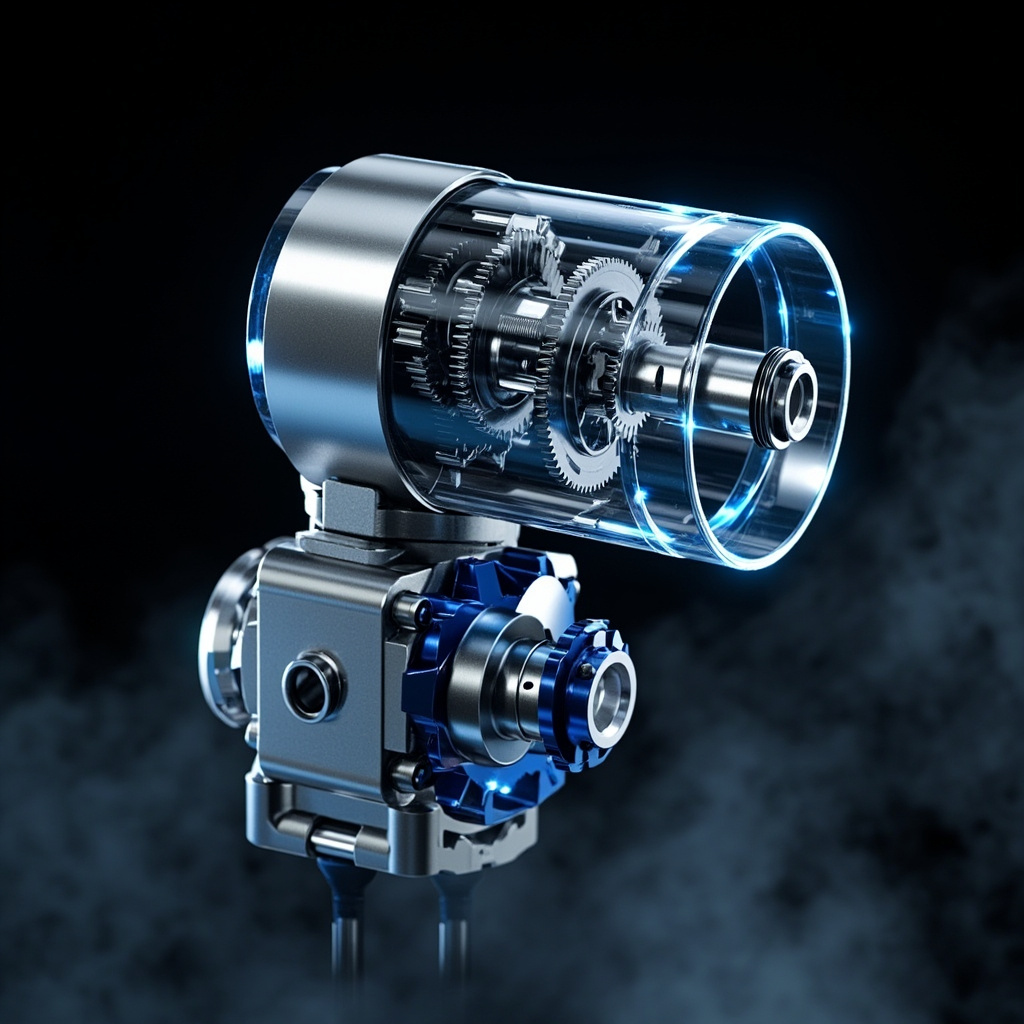
The RV Reducer (Rotary Vector Reducer) is a critical precision transmission component that has become the gold standard in modern robotics, particularly in industrial robotic arms. Known for its exceptional rigidity, high torque capacity, and zero backlash characteristics, the RV Reducer plays a pivotal role in ensuring that robots perform with the accuracy, repeatability, and reliability demanded by today’s automation industries. As robotics continues to evolve, understanding the function, design, and applications of the RV Reducer is essential for engineers, manufacturers, and automation professionals seeking to optimize their robotic systems.
What Is an RV Reducer?
An RV Reducer is a type of cycloidal-pin gear reduction mechanism developed to provide high reduction ratios in a compact form. Unlike traditional harmonic drives, the RV Reducer combines a planetary gear stage with a cycloidal disk stage, resulting in a two-stage reduction system. This hybrid design allows it to deliver superior performance in terms of torsional stiffness, shock load resistance, and positional accuracy, making it indispensable in six-axis industrial robots, CNC machines, and precision automation equipment.
Core Components and Working Principle
The architecture of an RV Reducer in robotics consists of several key components working in harmony:
- Input Shaft (Sun Gear): Receives rotational power from the servo motor and initiates the gear reduction process.
- Planetary Gears: Distribute the input torque evenly to the cycloidal disk through a first-stage reduction.
- Cycloidal Disk: Performs eccentric motion that drives the output through internal gear meshing.
- Output Shaft (Rotary Vector): Delivers reduced speed and amplified torque to the robotic joint.
- Needle Bearings and Pins: Support the cycloidal disk and reduce friction during operation.
- Housing: Provides structural integrity and protects internal components from contamination.
When the input shaft rotates, the planetary gears cause the cycloidal disk to perform an eccentric, rolling motion against the internal ring gear. The rollers and pins convert this motion into a smooth, low-speed, high-torque output. The two-stage reduction mechanism is what gives the RV Reducer its hallmark performance advantages.
Key Technical Specifications
Below is a comparative table summarizing typical specifications of common RV Reducer models used in industrial robotics:
| Model | Reduction Ratio | Rated Torque (Nm) | Backlash (arcmin) | Efficiency (%) |
|---|---|---|---|---|
| RV-20E | 81 – 243 | 20 | ≤ 1 | 85% |
| RV-40E | 81 – 253 | 55 | ≤ 1 | 85% |
| RV-80E | 81 – 243 | 120 | ≤ 1 | 87% |
| RV-160E | 81 – 243 | 240 | ≤ 1 | 88% |
| RV-320E | 81 – 243 | 480 | ≤ 1 | 90% |
⚠️ Pro Tip: When selecting an RV Reducer for a robotic joint, always oversize the rated torque by at least 25–30% to account for peak loads, acceleration phases, and shock impacts. Undersizing the reducer is one of the leading causes of premature failure in industrial robots.
Advantages of RV Reducers in Robotics
The RV Reducer has earned its dominant position in robotics due to several distinct advantages over competing reducer technologies:
- High Torsional Stiffness: The cycloidal design provides exceptional rigidity, critical for maintaining positional accuracy under varying loads.
- Zero or Near-Zero Backlash: Ensures precise repeatability, often within ±0.01 mm in robotic applications.
- Compact and Lightweight: The high reduction ratio in a small package makes it ideal for the compact joints of modern robots.
- High Shock Load Capacity: Can withstand sudden torque spikes common in start-stop robotic motions.
- Long Service Life: Properly maintained RV Reducers can exceed 20,000 operating hours.
- Excellent Efficiency: Two-stage design achieves efficiency ratings of 85–90%, conserving energy.
RV Reducer vs. Harmonic Drive: A Comparison
In the world of robotics reducers, the RV Reducer and Harmonic Drive are the two most common options. The table below highlights the key differences:
| Parameter | RV Reducer | Harmonic Drive |
|---|---|---|
| Reduction Ratio | 30 – 300+ | 50 – 320 |
| Torque Capacity | Higher | Moderate |
| Shock Resistance | Excellent | Lower |
| Lifespan | Longer (20,000+ hrs) | Shorter (10,000 hrs) |
| Cost | Higher initial cost | Lower initial cost |
| Best Application | Heavy-payload industrial robots | Lightweight precision robotics |
Applications in Modern Robotics
The RV Reducer in robotics is found in a wide range of applications where precision, power, and reliability are non-negotiable:
- Six-Axis Industrial Robots: Used in automotive welding, painting, and assembly lines.
- SCARA and Delta Robots: Provides fast, precise motion in pick-and-place operations.
- CNC Machine Tools: Drives rotary tables and tool changers with high accuracy.
- Medical Robotics: Enables precise movements in surgical and rehabilitation robots.
- Collaborative Robots (Cobots): Supports safe, smooth motion under variable loads.
- Aerospace and Defense: Powers precision positioning systems in satellites and UAVs.
Maintenance Best Practices
Browse topics Latest insightsCategories
Recent posts
Discover more from Xiamen Lisen Trading Co., Ltd
Subscribe now to keep reading and get access to the full archive.